
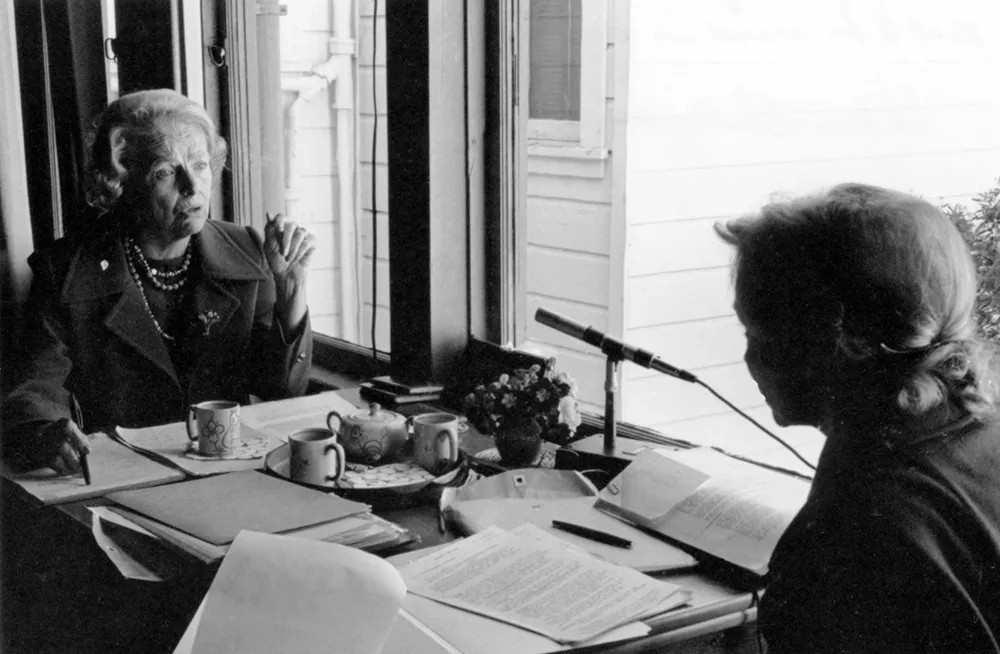
More information
Oral histories
The project pages below contain links to transcripts and where applicable, audio and video of interviews.
- Advocacy and Philanthropy — Individual Interviews
- African American Faculty and Senior Staff
- Agriculture and Natural Resources at University of California
- AIDS Epidemic in San Francisco
- Arts and Letters — Individual Interviews
- Athletics at UC Berkeley
- Bay Bridge
- Bioscience and Biotechnology
- California Coastal Commission
- California Fire Departments
- California State Politics
- Chicana/o Studies
- Commerce, Industry, and Labor — Individual Interviews
- Community and Identity — Individual Interviews
- Disability Rights and Independent Living Movement
- Dreyer’s Grand Ice Cream
- Earl Warren in California
- East Bay Regional Park District
- Economist Life Stories
- Education and University of California — Individual Interviews
- Food and Agriculture — Individual Interviews
- Forest Service Region 5
- Free Speech Movement
- Freedom to Marry
- Getty Trust
- Global Mining
- Goodwin Knight and Edmund G. Brown Gubernatorial Eras in California
- History Department, UC Berkeley
- Japanese American Confinement Sites
- Japanese American Intergenerational Narratives
- Jewish Community Federation Leadership
- Kaiser Permanente Medical Care
- Law Clerks of Chief Justice Earl Warren
- Leakey Foundation
- Marion and Herb Sandler
- Napa Valley Vintners
- Natural Resources, Land Use, and the Environment Individual Interviews
- Oakland Army Base
- On the Waterfront: Richmond, California
- Politics, Law, and Policy — Individual Interviews
- Port Chicago
- Portuguese in California
- Presidio Trust
- Ronald Reagan Gubernatorial Era
- Rosie the Riveter World War II American Home Front
- San Francisco Museum of Modern Art
- San Francisco Opera
- Save Mount Diablo
- School of Public Health, UC Berkeley
- Science, Technology, and Health — Individual Interviews
- Sierra Club
- Six Weeks in Spring: Managing Protest at a Public University
- SLATE
- Slaying the Dragon of Debt: US Fiscal Politics and Policy
- Suffragists
- U.S. District Court for the Northern District of California
- Venture Capitalists
- West Coast Cocktails
- Western Mining
- Women’s Movements in the United States
- Women Political Leaders
Collection guides
Oral History Center interviews touch upon most every theme of the human experience, so categorization is challenging. Each of our interviews falls into one of the categories listed on the Projects page and interviews are easily found through the search feature on our Overview webpage. But some topics of broad interest might still seem buried in out of the way corners of our archive. To help users find the oral histories that match their interests, we have created these Collection Guides. We plan to add to this list and, on occasion, update existing guides.
African Americans
Our collection contains a host of hidden gems: interviews with African Americans whose living memories date to the early 20th century at least, and offer first-person insights into the life of a Tuskegee airman, the contours of the West Coast jazz scene, the role of women in the Black Panthers, and much more. Projects and individual interviews address major historical themes in education, culture, law, politics, migration, the military, local history, and public service.
Read the African American Collection Guide, “A Host of Hidden Gems: Interviews with African Americans throughout the Oral History Center Collection.” (Created in 2020)
The Holocaust
Throughout the Oral History Center’s vast collection of interviews are more than 200 that reference the Holocaust. These oral histories document memories of the Holocaust from a multiplicity of perspectives, from the firsthand experiences of Jewish refugees who fled from Europe before it was too late, to Americans who first heard about the atrocities after the liberation of the camps. These oral histories may be particularly interesting to scholars as they provide a different lens for looking at the Holocaust, capturing the histories of those who were being interviewed for other reasons, but nonetheless spoke about the impact of the Holocaust on their lives.
Read the Holocaust Collection Guide, “Never Forget? UC Berkeley’s Oral History Center documents memories of the Holocaust for researchers and the public.” (Created in 2020)
San Francisco history
Many of California’s high-profile citizens — from governors and senators to actors, artists, and industrialists — have been interviewed by the Oral History Center. And no region is better represented in this collection than San Francisco and the Bay Area. This collection guide on San Francisco history was developed as part of San Francisco History Days, a showcase of local San Francisco history organized by the San Francisco Historical Society. This collection guide features the Bay Bridge Oral History Project and interviews with politicians, including three mayors, civic leaders, environmentalists, jurists, journalists, museum directors, firefighters, scientists, and other trailblazers. There are also videos about how trolly cars made their comeback in the city, and the first African American chief of the San Francisco Fire Department, as well as a podcast series on AIDS and First Responders in San Francisco and a panel discussion on Bay Area Women in Politics.
Read the San Francisco History Collection Guide, “UC Berkeley Oral History Center Proudly Participates In San Francisco History Days.” (Created in 2020)
Veterans of the Armed Forces
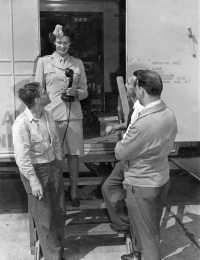
We proudly have documented the lives and service of hundreds of military men and women in multiple projects throughout our collection. We are aware that those whom we had the chance to interview were those who survived the battles, the wars, the hardships; they returned home, but many others did not. Because they are the ones who lived to tell those stories, we take seriously our role in preserving them for you and future generations to hear. Individual interviews and projects document WWI, WWII, the Korean War, and the Vietnam War. Oral history projects also preserve the voices of those who served on the home front during WWII.
Read the Veterans of the Armed Forces Collection Guide: “Preserving Veteran Experiences for Future Generations.” (Created in 2019)
Women of the University of California
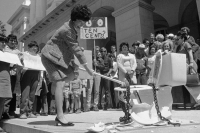
We have conducted hundreds of oral history interviews with University of California women — alumnae, faculty, staff, administrators, and philanthropists. In honor of the 150th anniversary of women at Berkeley, we created a comprehensive collection guide to these oral histories — containing more than 260 interviews. Reaching back to the class of 1895, these women were influential as educators, labor organizers, suffragists, child advocates, community organizers, novelists, artists, and much more. The guide can be downloaded or copied, and is fully sortable once copied or downloaded. The default sort is alphabetical by last name. Women related to UC campuses other than Berkeley are highlighted in gray.
View the Women of the University of California collection guide. (Created in 2020) For related content (podcasts and articles), see the oral history page of the UC Berkeley Women 150 website.
Find these interviews and all our oral histories from the search feature on our home page. To browse the entire Oral History Center collection, please see the Projects page.
Permissions
The Oral History Center (formerly the Regional Oral History Office or ROHO), a research group of The Bancroft Library, documents the history of California, the nation, and the interconnected global arena. OHC produces carefully researched, audio/video-recorded and transcribed oral histories, and interpretative historical materials for the widest possible use. In service to our mission, OHC makes full transcripts of the interviews available for download as a PDF.
Researchers are solely responsible for determining the copyright status of any materials they may wish to use, making fair use determinations, investigating the owner(s) of the copyright and, where necessary, obtaining permission for the intended use, as described below.
Quoting from the transcript
In keeping with Library Permissions Policies, researchers seeking to quote from a transcript in researchers’ own publications or other public displays do not need copyright permission to make uses that constitute “fair use” under copyright law. More information about fair use, as well as laws and policies outside of copyright that also affect publication permission can also be found on the Copyright Basics and Fair Use sections.
In the majority of cases, the copyright to the interview has been assigned to the Regents of the University of California (UC Regents). A copyright statement is available at the beginning of each transcript, and can be confirmed by Library staff if the statement is unclear or missing. The Library makes no representations about the accuracy or completeness of copyright ownership information in its collections.
As indicated in the chart provided on the Library Permissions Policy page, for instances in which a researcher’s intended usage of quotations from an oral history transcript would exceed fair use and it is the UC Regents who hold copyright to the underlying work, a researcher must request copyright permission to publish by completing and signing the Library’s Permission to Publish Request and Agreement.
Quoting from audio/visual interviews
Historically, all interviews were transcribed from their original recordings (usually on reel to reel tapes or cassettes) and interviewees were given the right to review, edit, and seal the interview if they wished. Many interviewees submitted edits, deletions, and seals upon reviewing the full transcript. When these edits were made in the final transcript that document became the document of record, meaning that end-users are required to quote from the transcript rather than the original recordings, which remain unedited.
We understand that there may be requests to listen to, and possibly use the audio recording, rather than the written word. In order to allow access to this material while preserving the intent behind having the transcript be the document of record, the following steps must be taken:
1. View the transcript
Most oral histories have published transcripts available, either online as a PDF or as a bound volume in the reading room. You will want to consult this transcript to get an idea of what quotes you are interested in using. The transcripts can be found by using the search function on our webpage or by searching the Library’s online catalog, UC Library Search.
2. Listen to the recording
If you would like to request to listen and/or view the original recordings in the reading room, submit a request for the media (tape, CD, DVD, etc.) found in the transcript in our online request system, Aeon. Instructions on how to do so can be found on the online Aeon guide.
In some instances, the original recording is fixed on a carrier that is not accessible for playback in the reading room, like reel-to-reel tape (listed as phonotape A or phonotape B in the catalog record). In this case, once your request is received via Aeon, library staff will work on obtaining an access copy of the material. You will be notified via email once the interview is ready for use in the reading room.
The Director of the Oral History Center will need to approve your request before access can be allowed, as all OHC produced A/V material is restricted.
3. Match audio to transcript
In order for a digital file of the A/V interview to be released and/or permission to be granted for you to publish the material, you will need to complete the Permission to Publish Request and Agreement.
Please include the following information in your request: the exact quote from the transcript (include a page number from transcript and block of text), the corresponding time codes from the media you wish to use, and your transcription of the recorded audio.
Crediting the Oral History Center
Whenever using, quoting, and publishing any materials produced by the Oral History Center, scholarly conventions require full source citation. The Library suggests the following format, or an equivalent format conforming to discipline-specific citation standards:
[Name of Interviewee], [Title of Interview], [Name of Interviewer], [Date of Interview], Oral History Center, The Bancroft Library, University of California, Berkeley.
Note that older interviews may have the former name of the Regional Oral History Office, please only use the current name of the Oral History Center when citing. When publishing in a digital medium, please include a link back to the OHC overview webpage.
Any questions not answered on this page or at the links provided may be sent to the Office of Scholarly Communication Services at schol-comm@berkeley.edu.