See all interviews
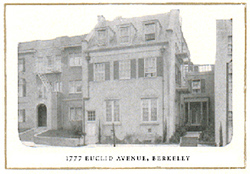 The Japanese American Confinement Sites / World War II American Home Front Oral History Project grew out of our long collaboration with the National Park Service on our broader Rosie the Riveter / World War II Home Front Oral History Project. This new group of oral history interviews was primarily funded by the Japanese American Confinement Sites Grant Program of the National Park Service. These interviews document the experiences of Japanese American students who attended UC Berkeley before or after being incarcerated during WWII.
 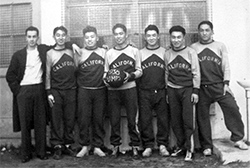 We also interviewed two Deaf interviewees in American Sign Language. We are also pleased to include donated interviews by the Japanese American Women / Alumnae of UC Berkeley [JAWAUCB], a Cal Band oral history, a life oral history with teacher Janet Daijogo, and related Regional Oral History Office [ROHO] interviews.
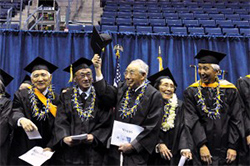
On December 13, 2009, approximately 500 Japanese Americans whose UC Berkeley educations were interrupted by Executive Order 9066 and their resulting incarceration, received honorary degrees at a special convocation ceremony at UC Berkeley. This highlighted the significant history of Japanese Americans at UC Berkeley prior to World War II, and the significant obstacles and challenges for those whose studies were interrupted by incarceration, as well as the challenge for the entire Japanese American community during WWII.
With this in mind, the Regional Oral History Office applied to the Japanese American Confinement Sites [JACS] Grant Program of the National Park Service to add to our Rosie The Riveter / World War II American Home Front Oral History Project with the National Park Service.
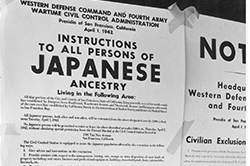 We were pleased to receive National Park Service JACS funding to complete oral history interviews with Japanese Americans, primarily those who attended UC Berkeley before--and in some cases after--incarceration during World War II. This coincided with The Bancroft Library's JACS grant to digitize and make available online the library’s extensive Japanese American incarceration materials, which have now become The Japanese American Evacuation and Resettlement Digital Archive. While we had some interviewee leads for this now elderly community, we immediately set about advertising our project on websites, newspapers, newsletters, radio, as well as networking with multiple UC Berkeley alumni organizations to recruit potential interviewees. We also received a donation of records from UC Berkeley's International House, which includes correspondence that fits alongside correspondence of University President Sproul and other university staff and academics who tried to allow for continued studies by Japanese American students, or to negotiate the transfer of students to other universities.
We soon learned that the Japanese American Women / Alumnae of UC Berkeley [JAWAUCB] conducted oral history interviews with individuals whose studies were interrupted by incarceration. From 2007-2011, Joyce Nao Takahashi and Mary Tomita of JAWAUCB headed their program to conduct audio interviews from the community. We met with Joyce and Mary to discuss our efforts, and to ensure their completed interviews could be donated to The Bancroft Library as part of our collection.
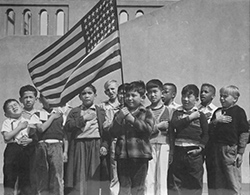 We also dialogued with the California Japanese American Alumni Association and other UC Berkeley alumni organizations to connect with living individuals who received honorary degrees in 2009. These efforts led us to a number of inspiring potential interviewees in their 80s and 90s. We informed potential candidates of our process and conducted a number of phone or in-person pre-interviews. From there we determined the best candidates for video recorded oral histories. Our final in-person video recorded oral history interviewees included several groups. As planned, we interviewed Japanese Americans who attended UC Berkeley before or after incarceration. Through colleagues at The Bancroft Library, we also met and interviewed two Deaf Japanese Americans--one who was incarcerated with her entire Deaf family--and one who was adopted by a California School for the Deaf teacher and avoided incarceration. Finally, we interviewed one woman whose family moved to Oklahoma to avoid incarceration, and later migrated during the war to Utah, where she and her family lived not far from Topaz camp where Japanese Americans like her were incarcerated.
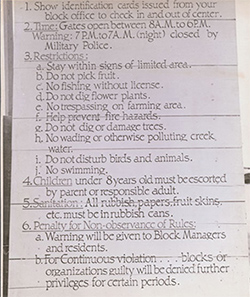 The majority of interviews were conducted at interviewees' homes or at The Bancroft Library. Most of the interviews were recorded in one or two sessions, ranging from one to four hours in total length. Most interviews included: family history and early years; attending UC Berkeley, especially those whose education was interrupted by incarceration; realities of incarceration for narrators and their families; transfer to universities in the Midwest or East Coast; and realities and challenges of post war re-entry into society. While some answers supported traditional literature on this history, many individual responses challenged the standard narratives, as can often happen with oral histories.
While we wish we had started sooner to more thoroughly document the experiences of Japanese American UC Berkeley students incarcerated during World War II, we are grateful to have found these unique individuals who generously shared their histories with us. This small collection adds to the overall collection of oral history interviews collection by Densho, the California Civil Liberties Public Education Program, and many others, some of which you can find on our Resources page. In coming years, we hope to work with other organizations to make all of the oral history interviews conducted on incarceration and the entire home front World War II experience more accessible, so these voices will continue to speak to scholars and students for centuries to come.
Special thanks
Khwaja Umar Ahmed, Student worker
California Japanese American Alumni Association
David de Lorenzo, American Sign Language interview coordinator and transcript editor
David Dunham, Project Manager and Interviewer
Geoff Froh, Densho
Christine Freeman, Oral history intern
Long Fung, Student worker
Candice Fukumoto, Volunteer Interviewer
Alexandra Hernandez, Assistant Program Manager and Historian, JACS Grant Program, NPS
Tom Ikeda, Densho
Kris Leonardo, Financial Analyst, UC Berkeley Library Business Services
Joe Lurie, International House, UC Berkeley
Kara Miyagishima, Program Manager, JACS Grant Program, NPS
Nichi Bei Foundation
Professor Franklin Odo
Samuel J. Redman, Interviewer, Rearcher, Co-grant author
Elizabeth Sabiniano, Student worker
Theresa Salazar, Curator, The Bancroft Library
Crystal Sasaki, Student worker
Grace Shimizu, Japanese Peruvian Oral History Project
Lu Ann Sleeper, American Sign Language Interviewer
Travis Thompson, Oral history intern
Wesley Ueunten, Asian American Studies, San Francisco State University
Mark Westlye, Oral history intern
Acknowledgments
This material is based upon work assisted by a grant from the U.S. Department of the Interior, National Park Service. Any opinions, findings, and conclusions or recommendations expressed in this material are those of the author(s) and do not necessarily reflect the views of the U.S. Department of the Interior. This material received Federal financial assistance for the preservation and interpretation of U.S. confinement sites where Japanese Americans were detained during World War II.
Under Title VI of the Civil Rights Act of 1964, Section 504 of the Rehabilitation Act of 1973, and the Age Discrimination Act of 1975, as amended, the U.S. Department of the Interior prohibits discrimination on the basis of race, color, national origin, disability or age in its federally funded assisted projects. If you believe you have been discriminated against in any program, activity, or facility as described above, or if you desire further information, please write to:
 Office of Equal Opportunity
National Park Service
1201 Eye Street, NW (2740)
Washington, DC 20005
Related resources
California Civil Liberties Public Education Program [CCLPEP]
Densho
Japanese American Citizens League
Japanese American Confinement Sites Grant Program [National Park Service]
Japanese Evacuation and Resettlement: A Digital Archive [The Bancroft Library]
Japanese American Internment and Relocation Records in the National Archives
Japanese American National Museum
Japanese American Relocation Digital Archives [JARDA, The Bancroft Library]
Japanese American Resources Guide [Tufts University]
Japanese American Women / Alumnae of UC Berkeley [JAWAUCB]
Japanese Peruvian Oral History Project (JPOHP)
Manzanar National Historic Site [National Park Service]
Military Intelligence School Historic Learning Center [NJAHS]
National Archives
National Japanese American Historical Society [NJAHS]
Nichei Bei Foundation
Telling Their Stories by Urban School of San Francisco

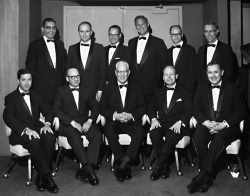 In 2004, fifty years after the U.S. Supreme Court's landmark decision in Brown v. Board of Education, UC Berkeley's Regional Oral History Office launched a project to document the experiences of law clerks of Earl Warren, Chief Justice of the Supreme Court of the United States. The project recorded video oral history interviews with all those surviving who clerked for the Chief Justice from the time he was appointed by President Eisenhower in 1953 until his retirement from the bench in 1969. These oral history transcripts are now available online. Two clerks were interviewed by ROHO in the 1970s as part of a multi-interview volume of edited transcripts, Earl Warren: The Chief Justiceship. That volume formed a small part of Earl Warren in California, a substantial oral history project centered on the Warren gubernatorial era in California, for which the Chief Justice himself was interviewed the year before his death.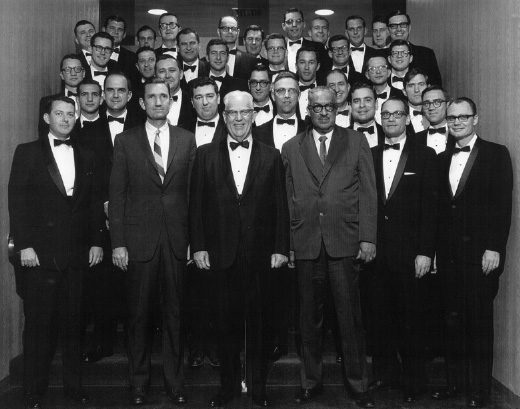
 The Earl Warren Era Project (recorded 1969-1979) documents the executive branch, the legislature, criminal justice and political campaigns during the Warren Era in California. Focusing on the years 1925-1953, the interviews also provide a record of the life of Earl Warren and yield new information on the changes wrought in California by successive Depression, war, and postwar boom.