Dreyer’s Grand Ice Cream


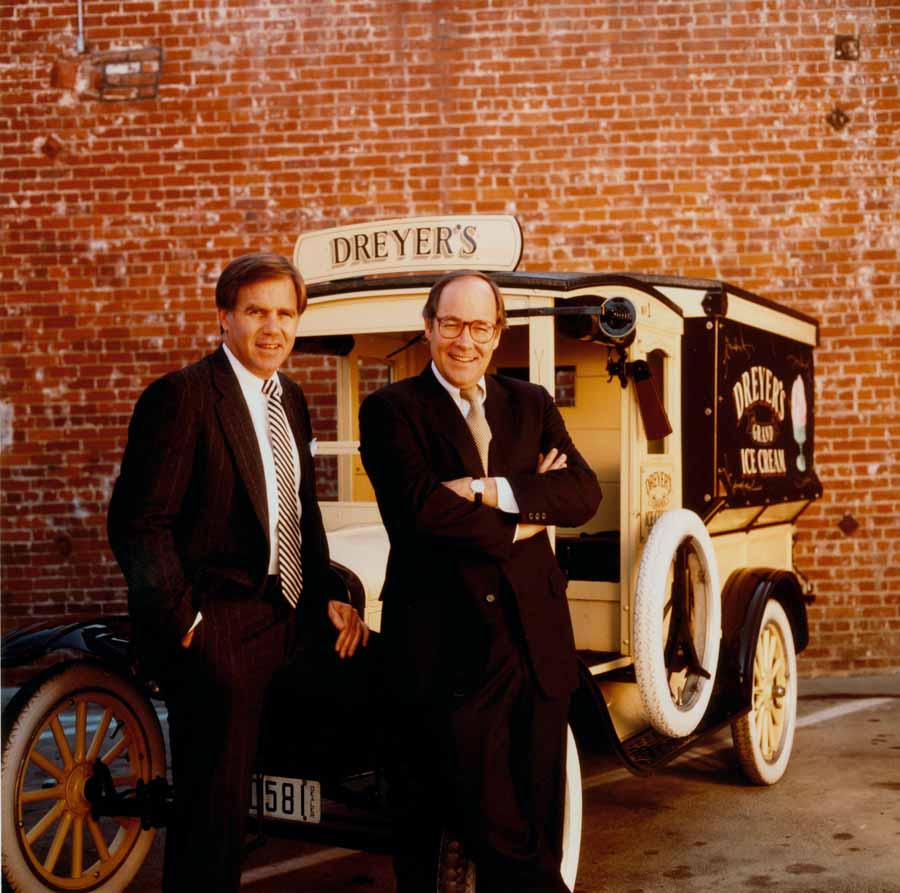
Dreyer's Grand Ice Cream - Gary Rogers and Rick Cronk
About the project 

The Oral History Center (then the Regional Oral History Office) of the Bancroft Library conducted an oral history project to document the history of the Dreyer’s Grand Ice Cream Company, interviewing some of the key people who built its local, national, and international presence. For the project, OHC conducted approximately 100 hours of interviews with the owners, investors, employees, and relevant individuals who helped make Dreyer’s Grand Ice Cream an international brand between 1978 and 2006. 

Historical context

Over the past century and a half, California’s coastal Mediterranean climate and irrigated inland valleys provided insightful entrepreneurs in the Golden State, and the Bay Area in particular, opportunities to become leaders in food and wine agribusinesses. As a result, the state served as the springboard for numerous food and wine businesses to establish profitable regional operations. By the 20th century, these businesses emerged as integral parts of multinational diversified corporations and key players in the global economy. Examples of these companies include: coffee giants Maxwell House, Hills Brothers, and Peet’s; bread giant Boudin; Golden Grain Macaroni’s Rice-a-Roni; chocolatiers Ghirardelli and Scharffenberger; and wine giants, including Gallo and Mondavi. Yet, the story is somewhat bifurcated in that food became more than a business as it emerged as a marker for regional identity predicated upon enjoying fine local foods and imbibing world-class wines. The Bay Area’s post World War II era also nurtured regional food educators and practitioners that elevated the status of the region’s foodways. Herb Caen, Cecilia Chiang, Doris Muscatine, Narsai David, and Alice Waters, among others, became modern food pioneers dedicated to establishing a regional food identity. In the end, the best of the regional foodways became a focal point for businesspersons to grow local food businesses into profitable national and global brands.


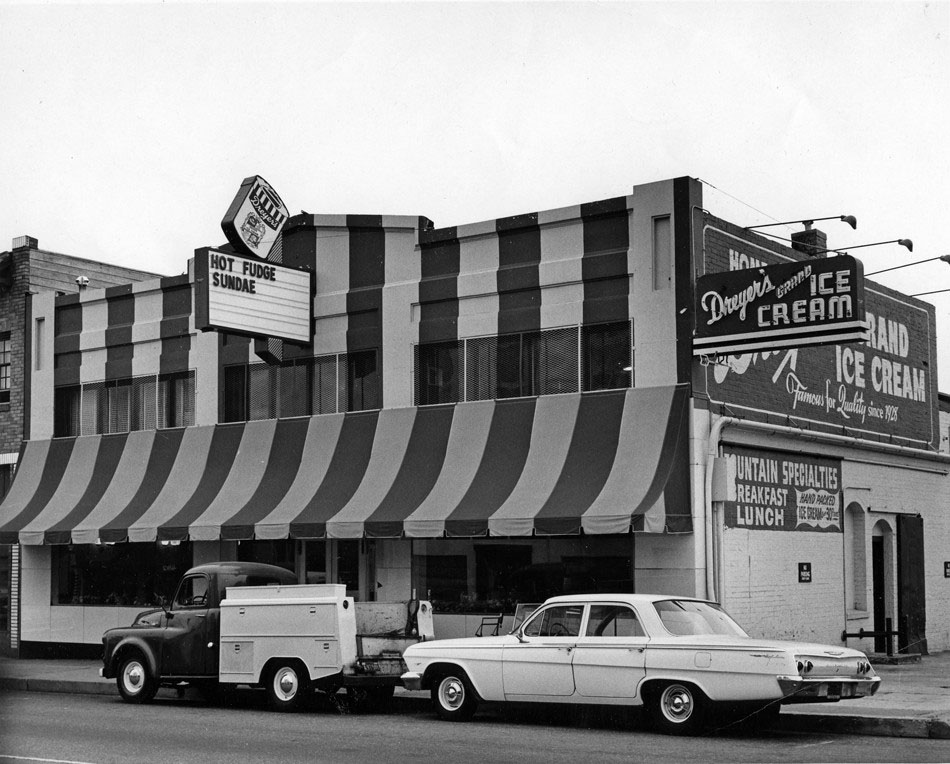
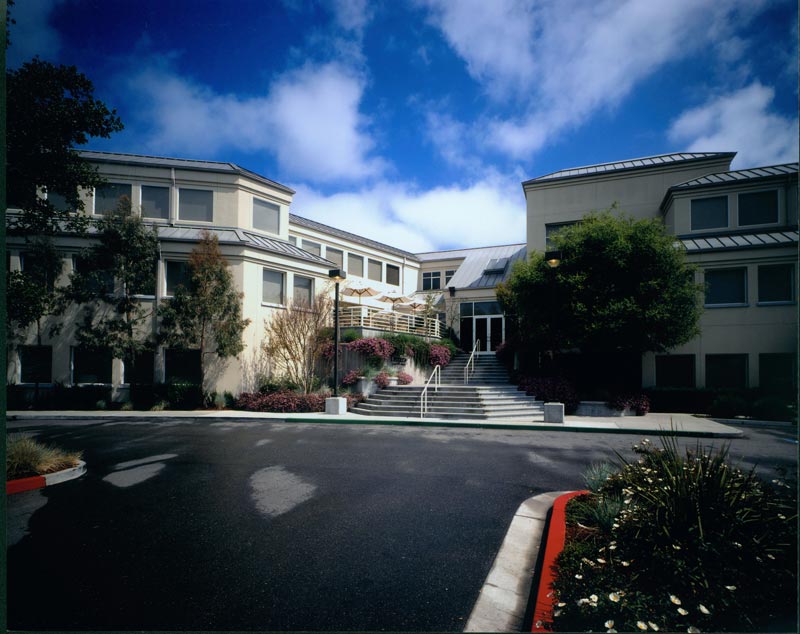
Dreyer's on College Avenue, 1960sDreyer's Headquarters, Present

Missing from the story is the role of Bay Area ice creams, such as Dreyer’s Grand Ice Cream, that played a vital role in this process. Dreyer’s serves as an important case study for the route of developing a local business and growing it to the regional, state, national, and eventually global marketplace. Founded in 1928 and opened on Oakland’s Grand Avenue, Dreyer’s ice cream business survived the challenges of the Great Depression and World War II by producing quality ice cream and developing new brand awareness built upon their invention of Rocky Road ice cream. Over the next few decades Dreyer’s became the largest American ice cream company and, in 1981, the corporation began to trade shares on the NASDAQ. The company's entrance into the global marketplace came in 2006 when Nestlé Corporation acquired 67 percent of their shares and thus became the world's largest producer of ice cream.

Project team (active circa 2010-14)

Victor W. Geraci, project director and interviewer; Shanna Farrell, interviewer; Robin Li, interviewer; Linda Norton, editor; and David Dunham, technologist

See all interviews

Project resources

Video excerpt


The Mother of All Parties


A brief timeline of ice cream and Dreyer’s Grand

200 BC

Widely believed to be the first “ice cream” developed in China by freezing a soft mixture of milk and rice and packing it into snow.

2nd Century AD

Arab medical historian Ibn Abu Usaybi offers first technical description of ice-making using salt, a technology that likely came originally from China.

7th Century

First documented evidence of ice cream production shows Chinese cooks fermenting, flavoring, and freezing a mix of buffalo, cows’, and goats’ milk during Tang Dynasty.

1660s

Using salt to freeze foods done in Europe for first time: sorbets and ices made with sweetened milk in Naples.

1686

After opening a chain of coffee houses across Central Europe, impoverished Palermo aristocrat, Francesco Procopio Dei Coletti, opens the first café in Paris. “Café Procope” debuts frozen ices, custards and creams, marking the beginning of the gelateria.

1700s

French begin using egg yolks in their ice cream production, marking the origin of custard-based (or “French-style”) ice creams. First known written ice cream recipes appear in the unsigned manuscript L’Art de Faire des Glaces (1700).

1744

Colonist William Black mentions “fine Ice Cream” being served at a dinner party given by Maryland Governor Thomas Bladen, the first record of American ice cream.

1777

Phillip Lenzi advertises the sale of ice cream at his New York City confectioners shop, likely the first retail ice cream location in the US (established c.1774).

1781

Lenzi-competitor Joseph Corre first to advertise the sale of “Ice Cream” by that name.

1792

First ice cream recipe published in the US appears in Richard Briggs’ The New Art of Cooker, According to the Present Practice (W. Spotswood, R. Campbell, and B. Johnson: Philadelphia, PA), 1792.

1802

Thomas Jefferson becomes the first US President to serve ice cream at the White House. Jefferson also credited with bringing “French-style” ice cream (made with egg yolks) to the U.S.

1807

First documentary evidence of an “ice cream cone” appears in the colored engraving “Frascati” by Parisian artist Louis-Philibert Debucourt. The picture depicts a young woman licking an ice-cream cone in the Neaopolitan-owned Café Frascati. This image challenges the commonly-held belief that the ice cream cone was invented at the 1904 St. Louis World’s Fair.

1820s

Augustus Jackson, former White House cook, moves to Philadelphia and begins catering business supplying ice cream to customers and several African American-owned ice cream parlors. Becomes one of Philadelphia’s wealthiest African Americans, often erroneously referred to as “the man who invented ice cream.” Credited with creating many new ice cream recipes.

1843

Nancy Johnson develops and patents first hand-crank ice cream maker. Sells patent to William Young for $200, who names it the “Johnson Patent Ice-Cream Freezer”

1851

Quaker dairy-delivery entrepreneur Jacob Fussell establishes the first large-scale commercial ice cream plant in Seven Valleys, Pennsylvania. Later moved to Baltimore to be closer to the consumer market.

1870s

Development of industrial refrigeration by German engineer Carl von Linde eliminates the need to cut and store natural ice.

1876

The Centennial Exhibition of 1876, held in Philadelphia, brought national attention to the Philadelphia ice cream culture and popularized “Philadelphia-style” ice cream, made without eggs, or with only egg whites.

1890s

In the United States, the French phrase, “à la mode,” used to mean “served with ice cream.”

1899

August Gaulin of Paris invents the homogenizer, which is used to develop the smooth texture of ice cream. US annual ice-cream production (in gallons): 5 million

1905

Thomas D. Cutler founds The Ice Cream Trade Journal. In New York City, Emery Thompson develops the gravity-fed batch ice cream freezer, which allowed for continuous production.

1906

As the galley boy, William Dreyer given the prestigious job of producing ice cream to celebrate his German ship's arrival in America. After a brief stint making ice cream in New York City, relocates to Northern California to begin a twenty-year apprenticeship with Peerless Ice Cream and National Ice Cream Company.

1909

Chicago leads the way towards safe dairy and ice cream production with the first compulsory pasteurization regulation. U.S. annual ice-cream production (in gallons): 30 million.

1919

U.S. annual ice-cream production (in gallons): 150 million

1920

First ice cream filling and packaging machines introduced by Mojonnier Brothers and Sealright.

1921

Dreyer opens his own ice creamery in Visalia and wins first prize at Pacific Slope Dairy Show.

1920s

Dreyer begins teaching ice cream courses as the Professor Advanced Ice Cream Manufacturing at the University of California, Davis and serving as an officer in the California Dairy Industries Association.

1923

Nizer Cabinet Company introduces the first automatic electric freezer.

1926

National Ice Cream recruits William Dreyer to run a large new plant in Oakland. Clarence Vogt of Lexington, Kentucky develops the first commercially adopted continuous-process freezer.

1928

Dreyer partners with successful Bay Area candy-maker Joseph Edy to found a small ice cream factory on Grand Avenue in Oakland, California, named the Grand Ice Cream Company, with a focus on creative innovation.

1929

Purportedly calming his nerves after Black Thursday, Dreyer adds walnuts (later replaced with almonds) to his chocolate ice cream and, using his wife's sewing shears, cut marshmallows into bite-sized pieces to make the first batch of Rocky Road, a name that gave people something to smile about in the face of the Great Depression. (note: An 1853 Australian confection, sold under the same name, was made of chocolate, marshmallow, nuts, and other fillers and sold to gold miners who travelled the “rocky road” to get to the Australian gold fields.) Prior to this, ice cream had been primarily sold in vanilla, chocolate or strawberry flavors and this marked one of the first flavor combination ice creams. Edy and Dreyer are also credited with creating Toasted Almond and Candy Mint.

1934

Thomas Carvelas, a Greek American, begins selling ice cream in New York and invents a freezer that allows him to make soft “Carvel” ice cream. Pairs American love of ice cream with the romance of car culture, and establishes an ice cream empire of roadside ice cream shops.

1946

Dreyer’s only son, William Dreyer, Jr. enters the business. Edy shifts focus exclusively to candy business.

1947

Joseph Edy and William Dreyer, Sr. officially dissolve their partnership.

1948

Dreyer builds a state-of-the-art ice cream plant in Oakland, California and renames the company Dreyer’s Grand Ice Cream, Inc.

1953

Dreyer retires and passes management of the company on to his son, “Junior,” though remains active in the company until his death in 1975.

1963

“Junior” sells the company to his key officers – Al Wolff, Bob Boone and Ken Cook.

1977

Fraternity brothers and struggling restauranteurs William Cronk and Gary Rogers buy Dreyer’s for $1.1 million.

1979

Cronk and Rogers introduce Dreyer’s to markets in Washington, Oregon and Arizona while remaining committed to the company’s unique Direct Store Delivery (DSD) model. Model includes using own trucks, drivers, routes and running in-story inventory to insure quality control. As East Coast-based Breyers Ice Cream (owned by Kraft Foods) and West Coast-based Dreyer’s expand into national markets, concerns about brand confusion leads Dreyer’s to agree to use the brand name “Edy’s” in the Eastern U.S. market.

1981

Sales reach $30 million, from $6 million at time of Cronk/Rogers acquisition. Dreyer’s goes public with shares traded on NASDAQ under the ticker symbol DRYR. Dreyer’s President Ken Cook enters the vanilla business, and since then Dreyer’s ice cream has been made with Cook’s Vanilla produced by the Cook Flavoring Company. $45 million Initial Public Offering.

1982

Official ice cream taster John Harrison invents Cookies ‘n’ Cream flavor ice cream.

1983

Begins expansion across the Rockies with introduction of Edy’s brand to St Louis, Milwaukee and parts of Ohio. At this point, Dreyer’s had experienced a 959 percent increase in sales since acquisition by Cronk and Rogers

1980s

As company expands, T. Gary Rogers composes the “I Can Make a Difference” philosophy defined by ten tenets, or “Grooves” that aim to empower individuals to realize their potential and promote a cohesive corporate culture.

1985

To accommodate growing East coast distribution needs, Dreyer’s acquires Maryland-based Berliner Foods Corporation.

1986

Acquires Midwest Distributing Company to enter Minnesota, Wisconsin and Michigan markets.

1987

Dreyer’s becomes first premium ice cream maker to introduce products for the health-conscious consumer, invents proprietary process that produces the first “light” ice cream. The company becomes distributor for Ben & Jerry’s, helping to cover the high cost of company-owned DSD trucks. Dreyer’s Grand Ice Cream Charitable Foundation established, supporting community, youth and K-12 public education programs, focused on communities that are home to Dreyer’s operating facilities. Embarks on five-year marketing plan to double sales by the end of the decade.

1989

In addition to an expanded distribution relationship, Dreyer’s begins manufacturing ten percent of Ben & Jerry’s “super premium” pint-sized ice cream at its plant in Fort Wayne, Indiana.

1990

Dreyer’s introduces new cholesterol-free frozen dessert called American Dream. Less than 1 % fat and 80 calories per three once serving.

1990s

Partners with Nissho Iwai Corporation to market and sell Dreyer’s products in Japan. Pressure from the U.S. forces Japan to lift restrictions on dairy imports, allowing Dreyer’s to ship directly to Japan from manufacturing sites in California. Rising dairy prices stifle market expansion.

1992

Unveils Dreyer’s and Edy’s No Sugar Added ice cream lines, to great success. Expands overseas sales to include exporting to countries in Asia, Pacific Islands, Caribbean and South America.

1993

Anglo-Dutch company Unilever outbids Dreyer’s for acquisition of Breyers. Unilever also purchases Gold Bond-Good Humor Ice Cream Company and renames the brand to Good Humor-Breyers Ice Cream Company, continuing the trend towards the globalization of the ice cream industry.

1994

Nestlé acquires approximately 30% of the company.

1995

Dreyer’s succeeds in 14-year struggle to exceed Breyer’s sale, becomes the leading packaged ice cream brand in the U.S. market. In celebration, the company held the Mother of All Parties (MOAP), chartering three DC-10s to bring all employees to Oakland for an “I Can” theme party. Also expands its charitable work with the launch of the Grand Expectations Program.

1996

Oakland City Council votes 8 to 0 to allow 57,000 square-foot $15 million expansion of Oakland manufacturing facility.

1996

30% jump in dairy prices due to drought conditions in dairy states and weakening demand for ice cream hurts profitability.

1998

200,000 people a year take the Dreyer’s factory tour. Michele Massari tour-guide

1998

For the first time Dreyer’s cuts 100 jobs, mainly through attrition, and sells some operations to trim costs and return to profitability. Ben & Jerry’s Homemade Inc. of Vermont rebuffed a purchase offer from Dreyer’s Grand Ice Cream, strains distribution relationship. New CFO Tim Kahn committed to “greening” the company, makes truck routes and freezer cycling more efficient.

1999

Virginia-based Mars confectioners partners with Dreyer's to create popular “mix-ins” ice cream products (Snickers Ice Cream bar). Ended with Nestlé buy-out in 2002.

1999

September Dreyer’s launches super-premium Dreamery line…to counter the category 42% Haagen-Daz and 38% Ben & Jerry shares of the super-premium market. These pint ice creams offer high margins of profitability. Dreamery line quickly gets 14% of market share.

1999

Nestlé USA joint venture with Häagen-Dazs Plc for super-premium line just at time Dreyer’s launching super-premium Dreamery line. But deal is really a move to someday-own Dreyer’s for its distribution system. Dreyer’s already distributes Nestlé novelties and Ben & Jerry’s.

2000

Company installs voice-enabled picking systems in warehouses to maintain worker comfort and productivity in 20 degrees below zero work environment. Distribution center productivity increases fifteen to twenty-five percent, mispick rates plummet.

2002

Nestlé acquires 67% of the company, with rights to purchase the rest by 2006. T. Gary Rogers retains post of Chairman and Chief Executive, President William F. Cronk

2003

W.F. (Rick) Cronk, President of Dreyer's, retires after 26 years in the ice cream business.

2004

Produced using a new churning process called “low-temperature extrusion”, Dreyer's and Edy’s Slow Churned™ Grand Light® Ice Cream has half the fat and a third fewer calories than full-fat premium and takes the ice cream world by storm.

2004

Dreyer’s expands with an East Coast plant in Laurel, Maryland.

2004

Dreyer's acquires Silhouette Brands and its low-fat and low-carb frozen snacks brands, Skinny Cow® and Skinny Carb Bar™.

2004

Dreyer’s buys franchise rights to all 236 Häagen-Dazs shops in the US from General Mills of Golden Valley, Minnesota.

2005

Dreyer’s debuts “Slow Churned” ice cream recognized as Best New Product of the year by four industry publications.

2006

Nestlé takes full ownership of Dreyer’s Grand Ice Cream, and becomes world’s biggest ice cream manufacturer with 17.5% of the market share.


Bibliography

Berger, Jonah, Michaela Draganska, and Itamar Simonson. 2007. “The influence of Product Variety on Brand Perception and Choice.” Marketing Science 26 (4) (Jul - Aug): 460-72.

Breedlove, L. B. 1932. “The Ice Cream Industry: Its Economics and Future.” The Journal of Land & Public Utility Economics 8 (3) (Aug): 234-47.

“Claim Check - Dreyer's/Edy's Grand Light Ice Cream.” 2004. Consumer Reports: 6.

Cohen, Ben and Jerry Greenfield. Ben & Jerry’s Double Dip: How to Run A Values-Led Business and Make Money, Too. New York; Simon and Schuster, 1997.

Dreyer’s Grand Ice Cream, Inc. “Grooves:” The Dreyer’s Philosophy, 2003 (pamphlet).

Dreyer's Ice Cream, Bakersfield. 2006. Dairy Record. 107 (8): 102-13.

EIP Associates and Oakland (Calif.) City Planning Dept. 1989. Dreyer's Grand Ice Cream Office Project: Draft Environmental Impact Report. San Francisco: The Associates.

Hawkes, Jerry M., James D. Libbin, and Jeremy D. Kohler. 2004. Can Ranch Owners Include the Ranch in an Investment Portfolio? Rangelands 26 (6) (Dec): 31-9.

"Ice Cream Scoops - Dreyer's/Nestlé Has Growing Pains.” 2004. Quick Frozen Foods International. 45 (3): 29.

“Ice Cream Scoops - Nestlé Closes (USD) 2.8 Billion Dreyer's Deal After Clearing US Regulatory Hurdle.” 2003. Quick Frozen Foods International. 45 (1): 10.

Kaven, William H., and David L. Call. 1967. Private-Label Marketing in the Ice-Cream Industry. The Journal of Marketing 31 (1) (Jan): 35-8.

Keller, Kevin Lane, and Donald R. Lehmann. 2006. Brands and Branding: Research Findings and Future Priorities. Marketing Science 25 (6) (Nov - Dec): 740-59.

Lane, Vicki, and Robert Jacobson. 1995. Stock Market Reactions to Brand Extension Announcements: The Effects of Brand Attitude and Familiarity. The Journal of Marketing 59 (1) (Jan): 63-77.

“New Dreyer's Grand Ice Cream Flavors.” 2002. Dairy Record. 103: 20-1.

“New Products & Marketing - New Product Review - New Dreyer's Grand Ice Cream Flavors, Indian Ethnic Cheese, Fruit Dips for One, and Organic Pudding.” 2002. Dairy Foods. 103 (5): 20.

Nowlis, Stephen M., and Itamar Simonson. 2000. “Sales Promotions and the Choice Context as Competing Influences on Consumer Decision Making.” Journal of Consumer Psychology 9 (1): 116.

Pava, Moses L., and Joshua Krausz. 1996. The Association Between Corporate Social-Responsibility and Financial Performance: The Paradox of Social Cost. Journal of Business Ethics 15 (3) (Mar): 321-57.

“Plant of the Year Dreyer's Grand Ice Cream.” 2006. Food Engineering 78 (4): 57-71.

“Plant Operations and Packaging - Plant Feature: Dreyer's Ice Cream,” Bakersfield. 2006. Dairy Foods. 107 (8): 102.

Quinzio, Jeri. Of Sugar and Snow: A History of Ice Cream Making. Berkeley: University of California Press, 2009.

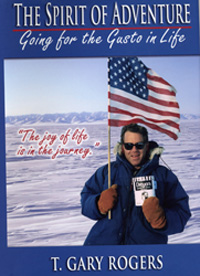
Book cover: The Sprit of Adventure: Going for the Guso in Life
Rogers, T. Gary. The Spirit of Adventure: Going for the Gusto In Life. Oakland: T. Gary Rogers, 2007.

Rogers, T. Gary and Jerome S. Engel, Berkeley Entrepreneurs Forum, Lester Center for Entrepreneurship & Innovation., and Audio Visual Consultants. 1994. Entrepreneurship and Ice Cream. Oakland, CA: Audio Visual Consultants.

“Rollout! Frozen Delights: New Häagen-Dazs Low-Fat Ice Cream, Plus the Latest Starbucks/Dreyer's Flavors.” 1997. Food Processing. 58 (2): 36.

Schmidt, Lisa. 1985. Rocky Road : Dreyer's Ice Cream vs. Rockridge. Express. 8 (8).

Simon, Carol J., and Mary W. Sullivan. 1993. The Measurement and Determinants of Brand Equity: A Financial Approach. Marketing Science 12 (1) (Winter): 28-52.

Simonson, Itamar, Stephen M. Nowlis, and Yael Simonson. 1993. The Effect of Irrelevant Preference Arguments on Consumer Choice. Journal of Consumer Psychology 2 (3): 287-306.

“Special Features - Light and Easy - Ice Cream Outlook 2006.” 2006. Dairy Foods. 107 (3): 32.

Targan, Barry. 1983. The Emperor of Ice Cream. The Sewanee Review 91 (1) (Winter): 17-52.

Related resources

Dreyer’s Corporate webpage

Dreyer’s Full Scoop newsletter

IceCream.com

Wikipedia Dreyer’s

Ice Cream Wiki

Nestlé USA

Breyers Ice Cream

Unilever

Ben & Jerry’s

Ciao Bella

History of Ice Cream

Foodtimeline.org

Free Speech Movement

See all interviews

About the project 

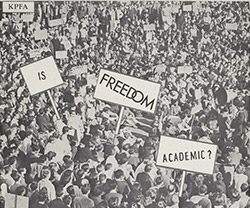
In the fall of 1964, the Berkeley campus of the University of California was rocked by the Free Speech Movement. These interviews recount the experiences of a cross section of participants in or witness to the events, including: student leaders and the lawyers who defended those disciplined and arrested; faculty who were in favor of and others who vehemently opposed FSM; ordinary students who as one freshman noted, were “trying to figure out what was going on. People were really caught by how important this was and trying to sort out the adult world response to it. You knew that this was a big deal.” Because of repeated massive demonstrations — 10,000 students surrounding a police car in the middle of Sproul Plaza; 800 people occupying the central administration building — Berkeley drew national attention. In the words of one interviewee, a journalist who covered the FSM for the nationwide Collegiate Press News Service: “FSM opened up everything — just blew out the tubes of being able to move large amounts of information across the country. It wasn’t exactly that Berkeley was the first place where this mechanism kicked in [political protest] but it was the place where it went critical.”

The Free Speech Movement Oral History Project consists of nearly fifty interviews — most are available here, but some are still in process. Interviews were conducted by Lisa Rubens, a historian and longtime interviewer for the Regional Oral History Office, between 1999 and 2001, after extensive meetings with an advisory committee. Dr. Rubens was also a student at Berkeley during the FSM and had been a witness to many of the major events of that movement. The project was funded by Stephen M. Silberstein as part of his generous gift to UC Berkeley for creating an FSM archive at The Bancroft Library and building the Free Speech Movement Café to honor Mario Savio and commemorate the movement.

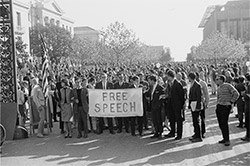
Marchers coming through Sather Gate with Free Speech sign to the UC Regents' meeting in University. Photoa courtesy of The Bancroft Library University Archives
The primary goal for these interviews was to fill in information about the history of the movement that remained undocumented. We wanted interviewees to talk about issues that had not surfaced in contemporary accounts — for example, the role of race and gender within the movement itself. We wanted to record the story of leaders who had not been interviewed previously, and to have them reflect on the interpersonal and social dynamics that influenced decision-making, in addition to the political and tactical issues that were discussed.

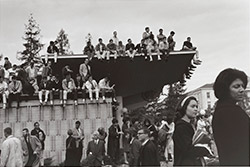
Photo of students sitting on roof of Golden Bear Center during rally, December 1964

We were particularly eager to interview “the troops” — students who volunteered to perform the myriad of seemingly mundane yet critical tasks, including those who typed the position papers and ran the ditto machines in an era before photo-copying, those who secured the amplification system used during the sometimes daily information and action rallies, or those who managed the housekeeping tasks for members of the FSM Steering Committee and the movement itself. We looked for interview subjects who could comment on the wide variety of activism that the movement engendered: The student who was sympathetic but who could tolerate attending only some of the rallies and missing only a few classes when a strike was called; the journalist who had not considered Berkeley a part of the student movement until FSM; members of SLATE, the radical student organization that had fought with the university since 1962, and now watched a new generation of leaders emerge; the junior professor who was one of a small minority in his department who voted to support the FSM; a university staff employee who felt compelled to take a stand. Associated Student Body President, Charlie Powell, who had never been interviewed before, is also a part of this collection. His narrative sheds light on the personal ordeal of leadership and the contingency of power.

The project sought to find subjects who represented the wide spectrum of political belief, as reflected in organizations which composed the FSM Executive Committee. This remains one of the least developed parts of the story and should be pursued. Inevitably an undertaking of this scope veers from its carefully mapped strategy and follows a seemingly un-plotted course. Sometimes an interviewee was selected because they had a good story to tell. Sometimes they were selected because they were currently engaged in activities that illustrated the continuities between FSM and contemporary social activism.

Photo of Free Speech Movement record cover

Another area of inquiry was the relationship between faculty and students during the movement. One of the many topics of discourse during the FSM was the size and mandate of the University of California and the need for educational reform. President Clark Kerr’s book, The Uses of the Multiversity, and the perceived intransigence and impersonalization of the administrations both for the university system-wide and at UC Berkeley, were widely criticized. For many, the FSM initiated a period of intense questioning of all aspects of their lives. Many students met with their professors and teaching assistants formally and informally to talk about the relationship of their studies to the events taking place on the campus, about the nature of education and citizenship and the function of civil protest. Faculty and graduate students in the departments of Political Science, History, and Sociology were chosen to illuminate these exchanges, because they represented some, but by no means all, of the more articulate and engaged members of the campus community. We also interviewed a faculty member who opposed the movement: Robert Scalapino, Department of Political Science, who chaired the Council of Departmental Chairmen and the University Forum at the Greek Theatre the day after the mass arrests. And we have included as well, undergraduate students who were episodic in their attention to the issues as well as their participation in the events that constituted the FSM. These are particularly useful for illuminating the multiplicity of concerns students had, the moral fervor that drove them, and for some, how they came to think of themselves as citizens.

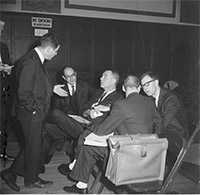
Photo of attorneys in courtroom at Veteran's Memorial Hall Berkeley

The lawyers who defended over 800 students arrested during the occupation of U.C. Berkeley’s Administration Hall, Dec. 2-3, 1964, had never been interviewed. At the time, this was the largest mass arrest in California history. As the news of the occupation and arrests spread, many lawyers came to Sproul Hall and to Santa Rita County Jail where the students were charged and booked, to volunteer their services. The legal defense was long and complicated and ably led by a team of six attorneys. Sadly, just as this project got underway, one of the attorneys, Stanley Black, died. Black had been the former law partner of Superior Court Judge Rupert J. Crittenden, who presided over the first trial. Some of the lawyers indicated that Black was picked in order to elicit the support of the judge. In the course of conducting these interviews, Attorney Malcom Burnstein made available the letters of arrestees written to Judge Crittenden, at the judge’s request, explaining their reason for occupying Sproul Hall. Now deposited in the FSM archives in The Bancroft Library, these letters are among the most immediate testimony and summary of participants’ beliefs even though they were written three years after the actual event.

The majority of interviews were conducted at the interviewee’s place of work or home. Most of the interviews were recorded in one session of an hour and a half in length; some went longer; others included two sessions. Usually interviews began with the interviewee telling where they were located in September 1964. This was followed by questions eliciting how they encountered, reacted to, and/or participated in the FSM. While none of these are life histories, questions about what factors in their background may have shaped their response to FSM are pursued.

These interviews provide insights into how students, staff, and faculty became engaged in a battle with the university and formed a movement to struggle for their civil right to advocate political action in the larger community as well as on the campus. They offer reflections on the academic, cultural, and social climate at the university in the years leading up to and following that fateful fall term of 1964. They situate the Free Speech Movement in the context of larger political issues and social movements that preceded the movement, such as the Civil Rights Movement and the Loyalty Oath controversy, and those which came after, such as the anti-Vietnam War activism.

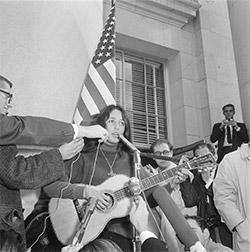
Photo of Joan Baez singing "We Shall Overcome" on Sproul Hall steps before demonstrators file in for sit-in. December 2, 1964

These interviews are not intended to provide a definitive history of the Free Speech Movement. They were conceived as a way to augment other forms of documentation. The number of interviews conducted was determined by the overall budget. In aggregate, and on their own, they offer a social memory and provide first person documentation of an important milestone in the history of the University of California and the Berkeley Campus, in the political life of California, and in the history of social activism in the United States. Beyond documenting what happened and how, these interviews reveal the personal qualities and skills and the array of background experiences and political consciousness that shaped how people responded to the crisis. They offer a glimpse, as well, into the intellectual, social, and cultural currents of the time — to be sure filtered by dramatic changes in subsequent history and distilled by individual the idiosyncratic nature of remembrance.

Advisory committee (2004)

  • Lynn Savio, FSM Veteran, Board Member, FSM-Archive, widow of Mario Savio
  • Susan Druding, FSM Veteran and Board Member, FSM-Archive
  • Waldo Martin, Professor of History, UCB
  • Michael Rossman, FSM Veteran and Board Member, FSM-Archive
  • Lisa Rubens, Historian, ROHO, Oral History Project of FSM Digital Archives
  • Elizabeth Stephens, Archivist, The Bancroft Library, FSM Digital Archives
  • Li Chi Wang, Professor, Ethnic Studies, UCB
  • David Wellman, Professor, Department of Community Studies, UC Santa Cruz
  • Reginald Zelnik, Department of History, UCB

Project resources

Select bibliography

Berkeley in the Sixties by Mark Kitchell [Documentary]

Freedom's Orator by Robert Cohen and Reginald Zelnik

The Free Speech Movement: coming of age in the 1960s by David Goines

Subversives: The FBI's War on Student Radicals and the Rise of Ronald Reagan by Seth Rosenfield

Related resources

Free Speech Movement Archives

The Free Speech Movement Digital Archive


Food and Agriculture — Individual Interviews

About the interviews

Interviews related to the history of food, food systems, and agriculture have been a mainstay of the Oral History Center research agenda since the 1950s. Interviews focus on several interlocking thematic areas including: social and cultural foodways; restaurants and cuisine; wine and wine growing; distilled spirits; small-scale and industrial farming; and agricultural economics and agricultural education. The interviews listed here typically were not conducted as part of an on-going project. Instead, the majority of these interviews document the singular contributions of individuals to food and agriculture in the United States and the larger global arena. Interviews are added to this subject category as they are completed. 

See all interviews

Project resources

Additional oral history interview projects with substantive content on the history of food and agriculture include:

Agriculture and Natural Resources at the University of California

Dreyer's Grand Ice Cream

Natural Resources, Land Use, and the Environment — Individual Oral Histories

West Coast Cocktails

Freedom to Marry

About the project

In the historically swift span of roughly 20 years, support for the freedom to marry for same-sex couples went from an idea a small portion of Americans agreed with to a cause supported by virtually all segments of the population. In 1996, when Gallup conducted its first poll on the question, a seemingly insurmountable 68% of Americans opposed the extension of marriage rights. In a historic reversal, fewer than 20 years later several polls found that over 60% of Americans had come to support the freedom to marry nationwide. The rapid increase in support mirrored the progress in securing the right to marry coast to coast. Before 2004, no state issued marriage licenses to same-sex couples. By spring 2015, 37 states affirmed the freedom to marry for same-sex couples, with a number of states extending marriage through votes in state legislatures or at the ballot box. The discriminatory federal Defense of Marriage Act, passed in 1996, denied legally married same-sex couples the federal protections and responsibilities afforded married different-sex couples — a double-standard corrected when a core portion of the act was overturned by the U.S. Supreme Court in 2013 in United States v. Windsor. The full national resolution came in June 2015 when, in Obergefell v. Hodges, the U.S. Supreme Court ruled that the Constitution’s guarantee of the fundamental right to marry applies equally to same-sex couples.

The Freedom to Marry oral history project represents the first major effort to document the vast shift in public opinion about marriage, the consequential reconsideration of our nation’s laws governing marriage, and the actions of individuals and organizations largely responsible for these changes. The project produced 23 interviews totaling nearly 100 hours of recordings. Interviewees include: Evan Wolfson, founder of Freedom to Marry; Kate Kendell, executive director of the National Center for Lesbian Rights; James Esseks, director of the ACLU’s LGBT & HIV project; and Thalia Zepatos, the movement’s “message guru,” who worked at Freedom to Marry as director of research and messaging. 

At the center of the effort to change hearts and minds, prevail in the courts and legislatures, win at the ballot, and win at the Supreme Court was Freedom to Marry, the national campaign launched by Harvard-trained attorney Evan Wolfson in 2003. Freedom to Marry’s national strategy focused from the beginning on setting the stage for a nationwide victory at the Supreme Court. Working with national and state organizations and allied individuals and organizations, Freedom to Marry succeeded in building a critical mass of states where same-sex couples could marry and a critical mass of public support in favor of the freedom to marry. This oral history project focuses on the pivotal role played by Freedom to Marry and their closest state and national organizational partners, as they drove the winning strategy and inspired, grew, and leveraged the work of a multitudinous movement.

See all interviews

Project resources

Freedom to Marry archive website

Freedom to Marry archives at Yale University

Education and University of California — Individual Interviews

About the project

The Oral History Center has taken the project of documenting the history of the University of California seriously since the inception of the Center in 1954. Moreover, the history of education and educational institutions more broadly has remained of keen interest to the Center. The project Education and University of California — Individual Interviews largely contains brief oral histories as well as longer life history interviews not otherwise part of a specific interview project. Instead, the majority of these interviews document the singular contributions of individuals to the University of California and education in the United States and the larger global arena. Interviews are added to this subject category as they are completed. 

See all interviews

Project resources

Additional oral history interview projects with substantive content on the history of education and the University of California include:

African-American Faculty and Senior Staff

Agriculture and Natural Resources at the University of California

Athletics at UC Berkeley

Free Speech Movement

History Department, UC Berkeley

Six Weeks in Spring: Managing Protest at a Public University

Economist Life Stories

About this project 

The impact of the discipline of economics in our society is hard to overstate. Economics structures government policy, guides decision-making in firms both small and large, and indirectly shapes the larger political discourses in our society. Since 2015, the Oral History Center has worked with the Becker Friedman Institute for Research in Economics at the University of Chicago to capture oral histories of selected economists associated with Chicago economics. Economist Life Stories is more than a collection of life histories; it chronicles the history of a scholarly community and institutions at the University of Chicago, such as the Graduate School of Business, the Cowles Commission, and the Department of Economics. It also reflects the achievements of faculty and students in the domains of economic policy-making and private enterprise around the world. Although this project focuses on the leaders and students of the University of Chicago Department of Economics, the Graduate School of Business, and the Law School, we hope to add more stories from economists around the world as the project expands.

See all interviews

Project resources

Acknowledgments

Financial support for this work was provided by the Becker Friedman Institute and members of the BFI Council, whose contributions are gratefully acknowledged.

Oral histories

Lester Telser Oral History

Now online, An Oral History with Lester Telser: Beyond Conventions in Economics. Lester Telser is Professor of Economics Emeritus at the University of Chicago. A student at Chicago in the 1950s, Dr. Telser was first a professor in the Graduate School of Business until 1964. Dr. Telser’s life work is the theory of the core, a variant of game theory that involves coalitions of agents as opposed to individuals working to maximize their advantage. He used sophisticated mathematics to study why and how certain forms of markets are organized without appeals to more established concepts in economics. As both a student and colleague at the Chicago economics department, and as a fellow at both the Cowles Commission and the Cowles Foundation, Telser is a key witness to the transformation of the field of economics after World War II.


Arnold Harberger Oral History

We are pleased to launch the next interview in the Economist Life Stories Project: Sense and Economics: An Oral History with Arnold Harberger. This oral history with Arnold Harberger was conducted in seven daylong sessions in Los Angeles from the fall of 2015 to the fall of 2016. Dr. Harberger is the Gustavus F. and Ann M. Swift Distinguished Service Professor Emeritus, University of Chicago, and Professor of Economics Emeritus, University of California, Los Angeles. He is perhaps most widely known for overseeing the Chile Project, which trained Chilean students in economics who then went on to found programs in economics and take up positions in the Chilean government. However, that story is merely one in Dr. Harberger’s 65-year career in technical assistance and education around the world. He has consulted for the U.S. government, numerous individual nation-states, as well as institutions such as the U.S. Agency for International Development, the World Bank, and the International Monetary Fund. Of equal importance is his career as a scholar, from his training and interest in international trade to his work in public finance, especially project evaluation and benefit-cost analysis. Throughout, this oral history explores his lifelong pursuit of “real-world economics,” research that both draws from and supports economic policy-making. 


George P. Shultz Oral History

Problems and Principles: George P. Shultz and the Uses of Economic Thinking is the first oral history in the Economist Life Stories Project. George Shultz is perhaps best known for his public service. He was appointed Secretary of Labor, the first Director of the Office of Management and Budget, and Secretary of the Treasury during the Nixon Administration, and later became Secretary of State during the Reagan Administration. But before that, he was professor of economics and dean of the Graduate School of Business at the University of Chicago. Mr. Shultz talks at length about his years at Chicago, but a thread throughout this life history is the economist’s way of thinking about and understanding the world. Most importantly, from his military service in World War II to his far-ranging policy analysis since he left public life, Mr. Shultz speaks of the importance of moving past rigid ideological positions to work with others to solve concrete problems.

The following interviews in our collection are relevant to the histories of agricultural economics and the New Deal, which are explored in the George S. Tolley interviews:

Cully Alton Cobb: The Cotton Section of the Agricultural Adjustment

Paul Schuster Taylor: California Social Scientist Volume I: Education, Field Research, and Family

Paul Schuster Taylor: California Social Scientist Volume II: California Water and Agricultural Labor

*The Reminiscences of Howard R. Tolley

Thomas C. Blaisdell Jr.: India and China in the World War I Era; New Deal and Marshall Plan; and University of California, Berkeley

*This interview belongs to the Columbia Oral History Project and is featured here to complement George S. Tolley's interview.

Additional oral history interview projects with substantive content on the history of economics:

Commerce, Industry, and Labor — Individual Interviews

Slaying the Dragon of Debt: U.S. Fiscal Politics and Policy


Presidio Trust

About the project

The Presidio of San Francisco is a new kind of national park. It is home to the spectacular vistas, nature, and programs that visitors would expect, as well as a community of residents and organizations who bring renewed vitality and purpose to this former military post. The Presidio Trust is an innovative federal agency created to save the Presidio and share it with the public.

The Presidio Trust Oral History Project captures new layers of the history of the Presidio. The project complements ongoing archaeological research and fulfills historic preservation obligations through interviews with people associated with the Presidio of San Francisco, for example: former soldiers, nurses, doctors, civilian workers, military families, descendants of Californios and Native Californians; environmental groups; and Presidio Trust and National Park Service employees. The interviews capture a range of experiences, including the legacies of colonialism, stories of service and sacrifice, the role of the Presidio in a range of global conflicts, everyday life on the post, and of how this post became a park. The Presidio Trust and the Oral History Center have embarked on a multiyear collaboration to produce these oral histories.

The goals of the Presidio Trust Oral History Project/Presidio are twofold. First, to create new knowledge about life on the post during peacetime, as well as during global conflicts, that illuminates the diversity of experiences and the multiplicity of voices that is the essence of Presidio history. And second, to share this knowledge with the public in ways that leverage the power of first-person narratives to allow people to see themselves reflected in the Presidio’s past so they feel connected to its present. The kinds of questions we seek to answer include: “How can the Presidio’s military legacy inform our national intentions?” and “How can examining the cultural mosaic of people living in and around the Presidio shape our understanding of the nation?”

There were two parts to this project, which are outlined below.

Life on the Post

The Presidio has served as a military reservation from its establishment in 1776 as Spain's northern-most outpost of colonial power in the New World. It was one of the longest-garrisoned posts in the country and the oldest installation in the American West. It played a key role in Spain's exploration and settlement of the borderlands, Mexico's subsequent control of the region from Texas to Alta California, and the United States' involvement not only in frontier expansion, but also in all major conflicts since the Mexican-American War of 1846-48. It was designated a National Historic Landmark on June 13, 1962.

The Presidio served as a U.S. Army Post from 1847 to 1994. This large military reservation at the Golden Gate developed into the most important Army post on the Pacific Coast. Over time its armaments evolved from smooth bore cannons to modern missiles. It became the nerve center of a coastal defense system that eventually included Alcatraz and Angel Island and that reached as far north as the Marin Headlands and as far south as Fort Funston (all these former military lands were later incorporated into the Golden Gate National Recreation Area). Eventually, there were five distinct posts at the Presidio, each with its own commander: the Main Post, Fort Point, Letterman General Hospital, Fort Winfield Scott, and Air Coast Defense Station at Crissy Field. Also on the 1,491-acre reservation were a Coast Guard lifesaving station and a U.S. Public Health Service Hospital.

In 1972, the Presidio of San Francisco — then an active installation — was included within the boundaries of the Golden Gate National Recreation Area. On October 1, 1994, after the post became excess to military needs, it was transferred to the National Park Service.

The Presidio offers a window into the changes in American society over a span of almost 150 years. The shift from an originally bachelor society where only officers could marry to a community with families and children, advances in modern medicine and health care at Letterman General Hospital, the introduction and expansion of the role of women in the military, the racial integration of the armed forces in advance of American society at large, all are integral to the Presidio's history and reflect American national history. The Presidio is home to one of the nation's finest collections of fortifications, landscapes, buildings, structures and artifacts related to military history.

Narrators include

Diana Brown
Leslee Coady
Rodrigo de la Concepcion
Norman Ishimoto
Steve Voris
 

The Presidio 27

On October 14, 1968, 27 prisoners in the Presidio Stockade broke ranks during roll call formation, sat down in a circle in the grassy yard, joined arms, sang We Shall Overcome, and asked to present a list of demands to the stockade commander that addressed the treatment of fellow prisoners and the conditions inside. Just days before a guard had shot and killed a prisoner, and GIs had taken to the streets of San Francisco in massive demonstrations against the war that came right up to the Presidio’s gates — the first anti-war marches organized by GIs and veterans in the nation. For staging this peaceful protest, amidst the heightened tensions of a country increasingly divided over the Vietnam War, the Army tried the 27 for mutiny, the most serious military offense. The actions of the 27 and their subsequent trials made headlines, shocked the Army and the nation, brought the GI movement onto the national stage, inspired the anti-war movement, catalyzed improvements in U.S. military prisons around the world, and ultimately helped to end the Vietnam War.

In 1968, as more and more soldiers began questioning the Vietnam War, going AWOL (absent without leave) and deserting the military, many flocked to San Francisco’s counterculture. Those who turned themselves in or were picked up by authorities, were brought to the Presidio, the nearest Army post, and held in the stockade. As its population swelled to nearly twice what it was designed to hold, stockade conditions became increasingly chaotic and overcrowded, a ticking time bomb. The average age of the Presidio 27 was nineteen and all were AWOLs. Most were from working-class backgrounds, some came from career military families, and only five had finished high school. Their convictions for mutiny came with sentences ranging from six months to sixteen years. Years later — and only after great personal hardship and sacrifice on the part of the Presidio 27, including years spent in federal prison — the military overturned their convictions on appeal and reduced their sentences. In the end, the appeals judge found that rather than intending to usurp or override lawful military authority, requirements for the charge of mutiny, the Presidio 27, in reading their demands to their commanding officers, were actually invoking and imploring the very military authority they had been charged with seeking to override.

Narrators include

Howard De Nike
Keith Mather
Richard Millard
Randy Rowland
Michael Wong

See all interviews

East Bay Regional Park District

About the project 

The East Bay Regional Park District (EBRPD) is a special regional district that stretches across both Alameda and Contra Costa Counties. First established in 1934 by Alameda County voters, the EBRPD slowly expanded to Contra Costa in 1964 and has continued to grow and preserve the East Bay’s most scenic and historically significant parklands. The EBRPD’s core mission is to acquire, develop, and maintain diverse and interconnected parklands in order to provide the public with usable natural spaces and to preserve the region’s natural and cultural resources. 

This oral history project — The East Bay Regional Park District Oral History Project — records and preserves the voices and experiences of formative, retired EBRPD field staff, individuals associated with land use of EBRPD parklands prior to district acquisition, and individuals who continue to use parklands for agriculture and ranching. 

The Oral History Center (OHC) of The Bancroft Library at the University of California, Berkeley, first engaged in conversations with the EBRPD in the fall of 2016 about the possibility of restarting an oral history project on the parklands. The OHC, previously the Regional Oral History Office, had conducted interviews with EBPRD board members, supervisors, and individuals historically associated with the parklands throughout the 1970s and early 2000s. After the completion of a successful pilot project in late 2016, the EBRPD and OHC began a more robust partnership in early 2017 that will result in an expansive collection of interviews. 

The interviews in this collection reflect the diverse yet interconnected ecology of individuals and places that have helped shape and define the East Bay Regional Park District and East Bay local history.

See all interviews

Related resources

East Bay Regional Park District